Sunday, November 25, 2012

Contradictions

"Contradictions" by Debbie Grayson Lincoln.
Funny, my five year old said, "It looks like the American Flag!"


In life, contradictions are inevitable, and life is reflected in the written word. Part of the greatness of literature is the ability to observe people, history and ideas through a magnifying glass, viewing the lives of others through their own eyes. In  our books, we find evidence of contradictions between the words and the lives of our literary ancestors in America. 

We see this contradiction in the life of Phillis Wheatley, an enslaved proclaimer of freedom and boaster in the glory of America's "goddess [. . .] divinely fair [with] olive and laurel bind[ing] her golden hair." Wheatley was a woman who would only know the harsh reality of poverty after her freedom was granted. Her life, in a way, contradicted the fate of a slave in her time. In class, someone said it doesn't matter that Wheatley was a slave-to me, her position in life is what made her poem to Washington such a novelty. 

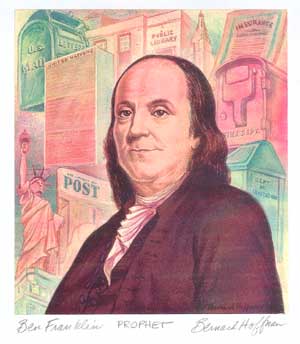
 Ben Franklin, an admitted walking contradiction in his own right, spoke of the virtue of chastity. "Rarely use venery but for health or offspring; never to dullness, weakness, or the injury of your own or another's peace or reputation." In the end, his reputation follows him as a notorious flirt and womanizer. It isn't proven that he actually was unfaithful or promiscuous, but you have to chuckle at the fact that his reputation was arguably injured in this area

There are many other examples of the contradictions between early American writers and their own lives or societies. We can easily find the irony in John Winthrop's message of love and service to one another, contrasted with the brutality and arguably hateful nature of his colony. Another example is Anne Bradstreet, so contradictory that our lessons were focused on her "many voices." 

What about these contradictions? Do they invalidate the writer? I like to think these ironies bring the humanity of the writer to the surface. They make the writing all the more interesting for its inconsistency-whether with itself or with the life of the penman. I can't help but think of the words we read in "Self-Reliance." 

With consistency a great soul has simply nothing to do. He may as well concern himself with his shadow on the wall. Speak what you think now in hard words, and to-morrow speak what to-morrow thinks in hard words again, though it contradict every thing you said to-day. — 'Ah, so you shall be sure to be misunderstood.' — Is it so bad, then, to be misunderstood? Pythagoras was misunderstood, and Socrates, and Jesus, and Luther, and Copernicus, and Galileo, and Newton, and every pure and wise spirit that ever took flesh. To be great is to be misunderstood.

Thursday, October 25, 2012

Ben Franklin As the Antithesis of Wilderness


The Work

I really liked Ben Franklin's Autobiography Part II. His reasoning for believing in a deity and "that the most acceptable Service of God was the doing of Good to Man" resonated with me, and seemed to be the most inclusive ideology of the writers we've read so far. That aside, what really pulled me into his story was the comical approach he took in presenting the problem of achieving virtue. He also had a good natured way of dismissing the possibility of being truly virtuous.


The Antithesis of Wilderness

His detailed reasoning behind his beliefs and his orderly plan of attaining virtue are good examples of Ben Franklin's antithesis to Wilderness. He creates the "Articles of Belief and Acts of Religion" and the 13 Virtues. He has a chart that he uses to track each offense against the virtues. I would say this is the opposite of wilderness.

The funny thing is that Franklin fails miserably in the area of virtue. "I was surprised to find myself so much fuller of Faults than I had imagined, but I had the Satisfaction of seeing them diminish. To avoid the Trouble of renewing now and then my little Book, which by scraping out the marks on the Paper of old Faults to make room for new ones in a new Course, became full of Holes: I transfer'd my Tables and precepts into the Tables and Precepts of the Ivory Leaves of Memorandum Book. . ." (288). These little swiss cheese sheets of paper sum up Franklin's entire purpose of including the story.

Another good example of his desire to corral even human nature is seen in this great quote:


"In reality, there is perhaps no one of  our natural Passions so hard to subdue as Pride. Disguise it, struggle with it, beat it down, stifle it, mortify it as much as one pleases, it is still alive, and will every now and then peep out and show itself. You will see it perhaps often in this History. For even if I could conceive that I had completely overcome it, I should probably be proud of my Humility" (292).


I think the fact that Franklin tries to subdue what he calls "natural passions" shows his tendency for order vs. wilderness. You can see his control and sensibility in the way he used an old dish for years until his wife finally bought him a single china bowl and silver spoon. You can see it in the one reference to nature in the text. "And like him who having a garden to weed, does not attempt to eradicate all the bad Herbs at once, which would exceed his reach and his strength, but works on one bed at a time. . ." (287). Franklin took things-problems, ideas, people, politics-and worked them into something new. If he couldn't he made sure he understood why. At least that's how I see it.

Also, this really great blog helped me understand the topic. See the quote below for a snippet:


"Ben Franklin didn't invent electricity. He invented the lightning rod (in other words, he took the wild, natural existence of it, and contained it. He cultivated it.). . .Everything is invented. Language. Childhood.  Careers. Relationships. Religion. Philosophy. The Future. They are not there for the taking. They don't exist in some Natural state. They must be invented by people. And that, of course, is a great thing."  -Maira Kalman


The Source for the beautiful paintings of Benjamin Franklin's life is here.

Wednesday, October 10, 2012

Anne Bradstreet

Anne Bradstreet's poetry does deal with concepts of wilderness. I think we discussed in class the fact that she came to north America with John Winthrop, and wilderness was her environment. Because of this, she can't help but use the wilderness to create images and metaphors in her writing.

In Contemplations, she wonders at the natural world. She discusses the autumnal leaves, the tall oak's old age, the "swift annual and diurnal course," etc. She asks the sun, "art thou so full of glory that no eye hath strength thy shining rays once to behold?" (100.) In stanza 8 she mentions her feeling of awe , "Silent, alone, where none or saw, or heard, in pathless paths I lead my wand'ring feet, my humble eyes to lofty skies I reared. . ." (101.)

Bradstreet's A Letter to Her Husband, Absent upon Public Employment was obviously written during a period of wilderness in her life. She makes statements such as, "My sun is gone so far in zodiac, whom whilst I 'joyed, nor storms, nor frost I felt. . ." (108.)


Wilderness: Captivity and Escape

The captivity narrative authors covered in class describe wilderness much differently than Ambrose Pierce did in An Occurence at Owl Creek Bridge. Although the authors viewed their captors differently, Mary Rowlandson and Alvar Nunez Cabeza de Vaca both describe wilderness as a harsh, dangerous and sometimes frightening place. In contrast, Amrose Pierce uses wilderness to allow his protagonist to momentarily escape his own captors before he is ultimately hung.

In The Relation of Alvar Nunez Cabeza de Vaca Alvar Nunez Cabeza de Vaca, the author describes the harsh climate and periods of famine. "From October to the end of February every year. . .they subsist on the roots which I mentioned"(31.) Among them we underwent fiercer hunger. . .we ate not more than two handfuls of prickly pears a day, and they were so green and milky they burned out mouths. . .Not being accustomed to going [naked] we shed our skins twice a year like snakes. The sun and air raised great, painful sores on our chest and shoulders. . ." (33). He speaks well of the people despite their strange customs. He seems to have more respect for the wilderness and the people able to live within the harshness of the wild.

Mary Rowlandson describes her experience in A Narrative of the Captivity and Restoration of Mrs. Mary Rowlandson as "the vast and desolate wilderness" (121.) She also underwent incredible hunger and cold, losing her six year old daughter to a fever (123) and feeling intense fear of the tribes people. She even went so far as to compare their dancing in the night to hell.

The Occurrence at Owl Creek Bridge portrays the wilderness as an escape. As the planter swims down the stream and notices the vibrancy of the amplified form of nature in his dream, he has hope. He reaches to bank and rolls in the sand, comparing it to "diamonds, rubies, emeralds." In the end, we learn that he is actually preparing to die, travelling inwardly toward his family for one last embrace with his wife, through the tunnels of the wild. He notices the vibrations of life all around him as he prepares to depart this world.

An Occurrence at Owl Creek Bridge

An Occurance at Owl Creek Bridge uses elements of nature and wilderness throughout the story to express the journey and realizations of the protagonist on his way to death. The one thing in the story that isn't natural-the bridge- is the place where he meets the soldiers and is ultimately hung. As he stands on the plank of wood, he looks down at the water. "He looked down at his "unsteadfast footing," then let his gaze wander to the swirling water of the stream racing madly beneath his feet. A piece of dancing driftwood caught his attention and his eyes followed it down the current. How slowly it appeared to move. . ." The "unsteadfast footing" seems to signify his situation and frame of mind, the water swirling sees to signify his fear. As he sees the driftwood flowing slowly down the river, we gain a sense of slowly moving time as he awaits his hanging.

His interaction with nature or wilderness is amplified after he had "fallen into the stream." He swam for his life and the whole time, he saw nature in a vivid and , at times, abstract way. "He felt the ripples upon his face and heard their separate sounds as they struck. he looked at the forest and on the bank of the stream, saw the individual trees, the leaves and the veining of each leaf-saw the very insects upon them. . . " He saw down the river, which seems to represent his life in some way, and reached the sandy bank. "It looked like diamonds, rubies, emerald; he could think of nothing beautiful which it did not resemble. The trees upon the bank were like giant garden plants." He later travels a road "as wide as a city" bordered by nothing civil. Overhead he saw "great garden stars" as he traveled to his home as fast as possible.

His wilderness is a journey and an essence of the precious life he knew he would lose. I think the representation of wilderness does line up with my definition of wilderness because it is a journey that he takes during his last moments of life. In other ways, it doesn't line up with my definition since my most basic definition is simply an untainted natural place.


I included the video we watched in class for anyone who may not have seen it before.

Wednesday, September 26, 2012

Growing Up in the Southwest: Native Culture

     I thought it might be relevant to share my experience growing up in Southern New Mexico, an area deeply infused with Native American culture and historical significance. I grew up in Deming, NM between The Gila National Forest and the Mexican border, west of the White Sands Missile Range.


In my hometown, there are Native families that carry the traditions. Pueblo murals are everywhere and Native artifacts make up most of  our little museum. There are highly publicized Pow Wows just a few hours north of us. The cliche "Indian" symbolism really is everywhere, for the sake of tourism. There are the casinos, and the occasional blocking of the Interstate by the Reservations for political reasons. Most of the people that live in New Mexico, though, tend to understand the importance of the People that used to live there freely.


In Elementary School, we recited the Pledges to the US Flag and the New Mexican Flag every morning.


                                                              "I salute the flag, 
                                                      Of the State of New Mexico,
                                               The Zia Symbol of perfect friendship.
                                                        Among United Cultures."


    The Zia is a symbol of the Sun. You can see the significance of the number four in the Zia symbol. There are four groups of four sun rays. In elementary school we learned that the Circle represents life and and the rays represent the directions (North, South, East and West) and the seasons. We also learned that the rays represent many different cultures coming together, connecting in the circle of life. I found a blog post that goes into the symbolism in greater detail is you are interested.


    A lot of people in the area, like anywhere, claim to be partly Native. The thing about New Mexico is that the culture is deeply alive in the people. Many of Native descent still show some interest in their culture (heck, even the snowbirds at least like to wear "inspired" jewelry and clothing). In the fifth grade we had a classmate whose brother took part in sun dances and other Native American rituals. He came to class and shared his experiences, which included piercing the skin of his chest with bone, tied by leather chords to a pole and pulling until the strings (or his skin) broke. He also told stories and sang for the class.


The Storyteller is an iconic image that I grew up with. The stories are a central part of Native American pride and history, so the Navajo and Pueblos both make statues like this one, sand paintings and dolls to represent the importance of the storyteller in their culture. Coincidentally, here in Ohio I have a 92 year old neighbor. Her husband was from Albuquerque and she has a case of these dolls in her home and his grandmother's handwoven rug on her wall-proof that the cultural pride runs deeply.


The Kachina Dolls are Hopi, which are more identified with Arizona. However, the Native Americans didn't recognize our state lines, and Tuscon is about three hours from my hometown. Kachina Dolls were originally meant for ceremonies or for learning, not for play. They represent ancestors, important figures in the culture, etc. Now, you can buy a Kachina doll easily online or at any touristy "trading post" in the Southwest.

Zunis, Pueblos and all the Pueblo Tribes, Mimbres, Navajo, Sandia, Apache, Hopi...the list goes on. There are twenty two native tribes of New Mexico. When I think about the sheer number of people that were corralled in the Four Corners it still shocks me. It was unnatural to force so many tribes and nations in such a small area.

It's hard to explain if you haven't been there, but New Mexico is very alive. The Native culture persists on some level today, though it obviously is a shadow of the past, as well as an infusion of our time and old symbolism. There are still remnants of the past, large and small. The Gila Cliff Dwellings are like a fossilized village etched in the sides of the Mountains. On a smaller scale, it isn't terribly uncommon to find arrowheads and small shards of pottery in the desert where I grew up, as well as fossils on the rock that bring a lot of visitors every year.

So, that's a kind of wordy post about my experience with native American culture. If you are interested, I included some links. If you ever have a chance to visit the Southwest I highly recommend it, there's nothing quite like it.

Gila Cliff Dwellings
Navajo blog and Creation Story

The Mimbres "Indians" (from my area)
The Trail of Tears

Native Wilderness

Native Americans use wilderness in their tales to represent many themes and ideas. They lived closely with nature and had deep respect for the creatures and the landscape. This respect and communion with the earth is evident in the roles played by creatures, plants and earth in their tales.

     The Pima and Iroquois creation tales have many differences, but carry similar themes. Both peoples describe creation with respect to their natural environments. The Pima of the Gila River mention grease wood, coyotes and buzzards, the sun and moon. These all are elements that are prominent in the southwest. If you have been to the southwest, you will understand how amazingly close and bright the stars and the moon seem there. The Iroquois of the  Great lakes and Hudson River talk about great water beasts, fruitful vegetation  and a turtle. Both tales discuss darkness and light,

My definition of wilderness, a place untainted by civilization, a great journey,etc. can be compared to these stories. I don't think they are exactly the same, but they aren't in disagreement either. I think the indigenous people of the Americas were much more connected to the land than I am capable of understanding. They speak of the earth and of wilderness as people that live among it. As much as I love nature, I am separate from nature, so my perception is naturally different. 

An interesting thought, as an aside, is the Iroquois tale's discussion of the bad mind and the good mind. The good mind "continued the works of creation" and " appointed thunder to water the earth by frequent rains, agreeable to the nature of the system." The bad mind "attempted to enclose all the animals of game in the earth, so as to deprive them from mankind. . ." I thought that was interesting.